Choosing a reliable cosmetic packaging manufacturer is not simply about finding a supplier with attractive bottles and competitive prices. For skincare, fragrance, makeup, and personal care brands, packaging needs to work at several levels at the same time. It should suit the formula, protect the product, match the brand image, remain consistent during mass production, and arrive in good condition.
This is why the right cosmetic packaging manufacturer should be evaluated as a manufacturing partner rather than simply a packaging seller. A supplier may have hundreds of bottle designs in a catalog, but that does not necessarily mean the company can provide stable quality, accurate customization, suitable dispensing components, or dependable production support.
For brands sourcing glass packaging, the evaluation becomes even more important. Glass bottles and jars involve material selection, bottle structure, neck finish, closures, decoration, filling compatibility, transportation protection, and production consistency. A reliable manufacturer should be able to discuss these details with you before mass production begins.
So, how do you choose a reliable cosmetic packaging manufacturer? The following points can help you compare suppliers more effectively and avoid choosing a manufacturer based only on product appearance or price.
The first thing to check is whether the supplier actually specializes in cosmetic packaging. Packaging requirements are different from one industry to another. A manufacturer that mainly produces ordinary glass containers may not have the same experience with skincare bottles, perfume packaging, serum droppers, lotion pumps, or cosmetic jars.
Look at the manufacturer's product range and the applications it serves. A supplier with experience across skincare, fragrance, personal care, and beauty products is usually better positioned to understand the different requirements involved in these products.
For example, a serum may require a dropper or precision pump, while a perfume usually needs a spray system. A cream may be better suited to a wide-mouth jar, while a lightweight lotion may require a pump bottle. These decisions involve more than appearance because the packaging has to work with the formula and the intended user experience.
LISSON focuses on cosmetic, beauty, skincare, fragrance, and personal care packaging. Its product range includes skin care glass bottles, perfume bottles, glass dropper bottles, and cosmetic packaging sets, giving buyers different packaging formats to compare within one supplier.
A manufacturer with a focused product range can also make communication easier. Instead of explaining the basic requirements of cosmetic packaging to a general container supplier, you can discuss bottle capacity, dispensing systems, glass finishes, decoration, compatibility, and customization directly with a team familiar with these applications.
A professional website alone does not prove that a company is a manufacturer. One of the most important steps when evaluating a cosmetic packaging supplier is checking its actual production capability.
Ask where the products are manufactured, what production processes are available, whether customization is handled internally, and how the supplier manages quality control. If the supplier mainly resells products from several unrelated factories, quality and delivery can become less predictable.
Production capability is particularly important for customized cosmetic packaging. A project may involve bottle development, mold production, glass forming, surface treatment, logo printing, coating, electroplating, component assembly, inspection, and final packing. The more steps that can be coordinated under one manufacturing system, the easier it is to maintain consistency.
LISSON was established in 2013 and focuses on glass packaging for cosmetics and beauty applications. The company also provides OEM and ODM support for customized packaging projects, allowing buyers to discuss product development, decoration, and production requirements with one supplier.
For a buyer, the important point is not simply the number of machines or production lines. What matters is whether the manufacturer's production system is suitable for your expected order volume and whether the company can maintain the same specifications from the first batch to later repeat orders.
A reliable cosmetic packaging manufacturer should offer enough options to match different product types without forcing every formula into the same bottle design.
For skincare brands, this may include serum bottles, lotion bottles, dropper bottles, cream jars, and complete bottle-and-closure sets. For fragrance brands, the range may include different perfume bottle shapes, spray systems, decorative finishes, and customized closures.
It is also useful to look at how detailed the supplier's product information is. A professional product page should provide useful information such as material, capacity, closure type, application, customization options, and available decoration methods.
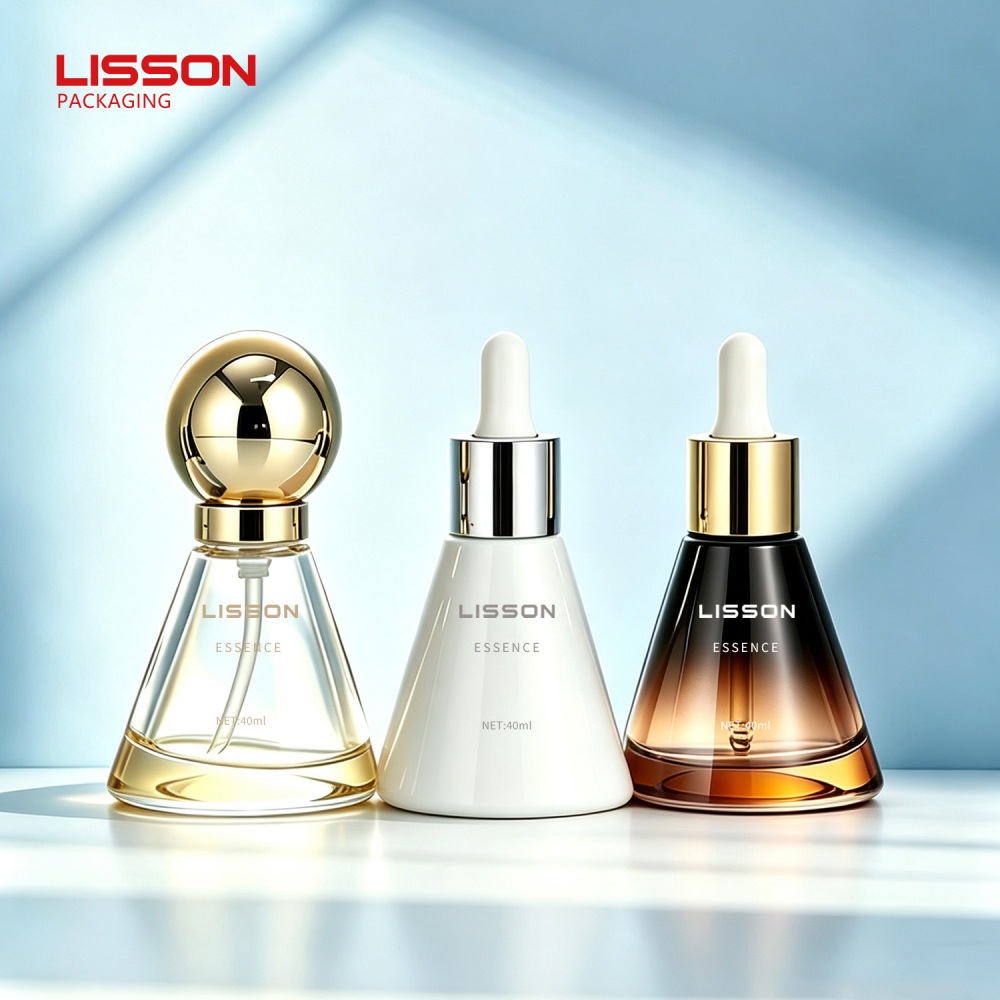
For example, LISSON's tapered glass essence bottle uses a heavy-base glass structure and a dropper system. It can be customized with different colors, logo printing, and surface finishes, making this type of packaging suitable for skincare products such as facial serums and other liquid formulations.
This type of product information is useful when comparing suppliers because it tells you whether the manufacturer understands the relationship between the packaging structure and its intended application.
A bottle that looks perfect in a catalog may not necessarily be suitable for your product. Formula compatibility should therefore be discussed before you place a large order.
Start by telling the manufacturer what type of cosmetic product you are packaging. Include information about viscosity, ingredients, sensitivity to light or oxygen, dispensing requirements, and expected usage.
For example, a facial serum may need a dropper that provides controlled dosing. A lotion may require a pump with an appropriate output. A rich cream may be easier to use in a jar rather than a narrow-neck bottle. Products containing light-sensitive ingredients may also require colored, frosted, or opaque packaging depending on the formulation.
The dispensing component is just as important as the glass container itself. The bottle, pump, dropper, cap, liner, and other components need to work together. Leakage, inconsistent dosage, evaporation, or pump failure can create problems after the packaging has already entered the market.
When evaluating a manufacturer, ask whether it can provide samples before mass production. If possible, test the actual packaging with your formula to confirm dispensing performance, sealing, compatibility, and user experience.
For cosmetic glass packaging, material quality affects both appearance and performance. Check the glass thickness, clarity, bottle weight, dimensional consistency, and overall finish. If the project uses pumps, droppers, sprayers, or special caps, evaluate those components as well.
Cosmetic packaging is often handled repeatedly during filling, transportation, retail display, and consumer use. Small differences between batches can become noticeable when products are placed next to each other on a retail shelf.
For premium brands, consistency is especially important. The color of the glass coating should remain stable, logo printing should be positioned consistently, and components should fit securely. A cosmetic packaging manufacturer should have a quality control process that covers these details rather than checking only whether the bottle is physically intact.
For example, a cosmetic packaging set may combine a glass bottle with a pump and cap. LISSON offers customizable glass skincare packaging sets with options for logo, color, shape, and surface decoration.
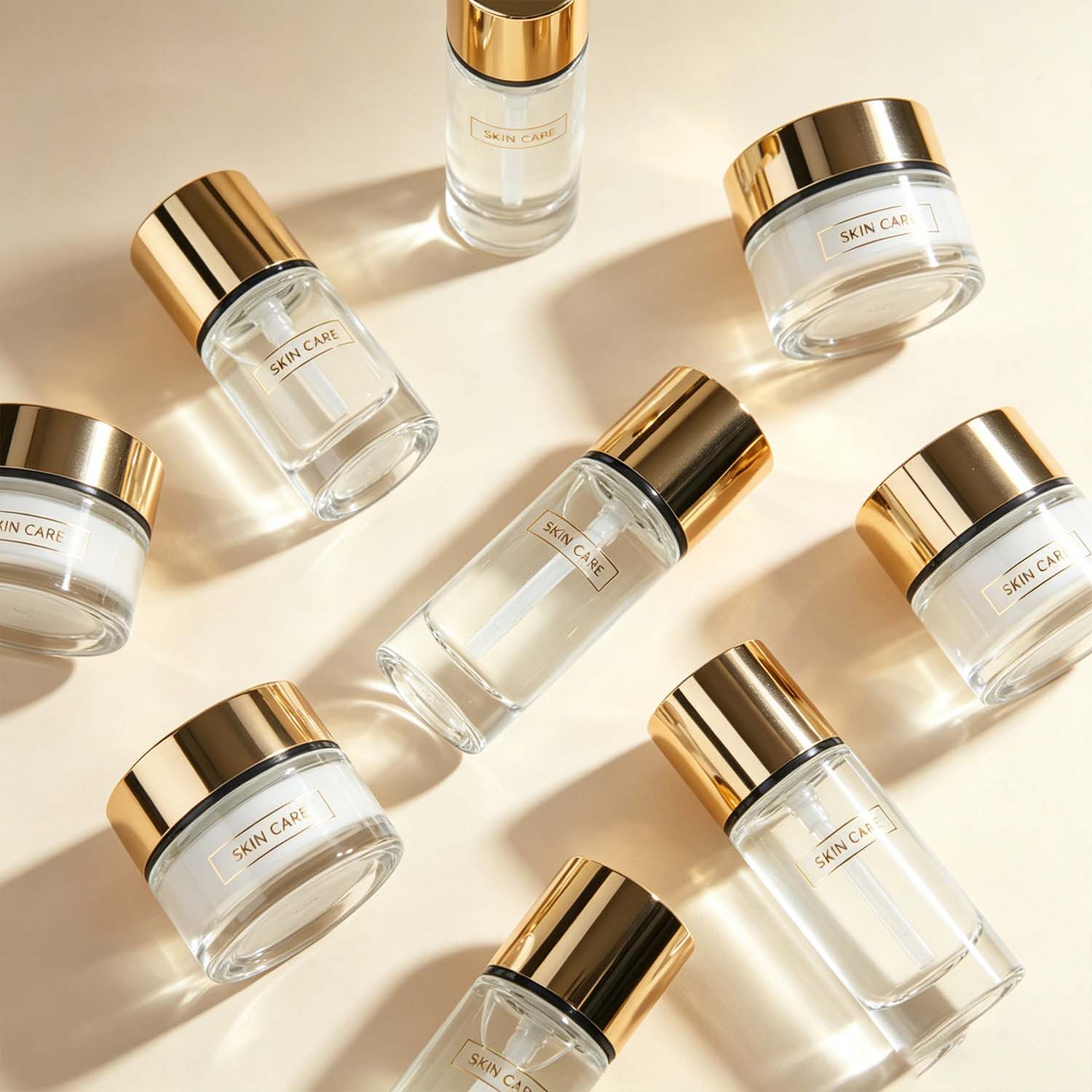
When comparing manufacturers, do not focus only on whether a supplier can produce a particular shape. Ask whether it can keep the same appearance and component performance when the order moves from samples to mass production.
Many beauty brands need packaging that looks different from standard stock bottles. This can involve custom colors, logos, surface finishes, bottle shapes, caps, pumps, labels, and secondary packaging.
A reliable cosmetic packaging manufacturer should be able to explain which customization options are suitable for your project and what each option means for cost, production time, minimum order quantity, and appearance.
Common decoration methods for glass cosmetic packaging include silk-screen printing, hot stamping, frosting, color coating, spraying, electroplating, and labeling. Not every finish is suitable for every bottle design, so the manufacturer should be able to recommend the appropriate process rather than simply offering every option.
Customization should also be considered from a production perspective. A design may look attractive in a digital rendering but become difficult to manufacture consistently. An experienced manufacturer can identify these issues early and suggest practical adjustments.
If you are developing a new packaging concept, it is useful to work with a supplier that provides OEM and ODM support rather than simply selling existing products. This can simplify communication between design, sampling, and production teams.
Price is important, but it should not be considered separately from minimum order quantity and lead time.
A manufacturer may offer a lower unit price but require a very large MOQ that does not fit your launch plan. Another supplier may have a reasonable MOQ but an unstable lead time that makes it difficult to maintain inventory. The better option depends on your production schedule, sales forecast, and packaging requirements.
Ask the manufacturer to clearly explain:
For long-term sourcing, repeat-order stability can be more important than the initial quotation. A packaging manufacturer should be able to reproduce the same bottle specifications, colors, decoration, and components when you place your next order.
Samples are one of the simplest ways to evaluate a cosmetic packaging manufacturer before making a larger commitment.
Do not judge the sample only by appearance. Check the bottle dimensions, weight, glass clarity, surface finish, closure fit, pump performance, dropper operation, and overall packaging quality.
If possible, fill the sample with your actual formula. Test how the product dispenses, whether the closure remains secure, whether the formula interacts with the packaging, and whether the packaging is convenient for consumers to use.
For customized projects, the sample is also an opportunity to confirm the color, logo position, printing quality, coating, cap finish, and overall proportions.
A reliable manufacturer should be comfortable with this process because samples protect both sides. The buyer can confirm the packaging before production, while the manufacturer can identify technical issues before committing to a large production run.
Packaging sourcing rarely ends when the bottle is selected. A new cosmetic product may require bottle development, component matching, decoration, packaging, inspection, and shipment coordination.
This is why one-stop manufacturing support can be valuable for brands that do not want to coordinate several suppliers. If the bottle comes from one factory, the pump from another supplier, decoration from a third party, and assembly from another company, communication becomes more complicated and responsibility can become unclear when something goes wrong.
A manufacturer that can coordinate multiple stages can simplify the process. LISSON provides cosmetic glass packaging and customization services for beauty and personal care applications, helping brands coordinate product selection, decoration, and manufacturing requirements through one supplier.
For buyers, this means fewer separate communication points and a clearer production process. It can be particularly useful for private-label skincare brands, fragrance companies, contract manufacturers, and brands preparing a new product line.
The quality of communication before an order is often a good indicator of what working with the supplier will be like later.
A reliable manufacturer should ask questions instead of immediately sending a price. If you say that you need a 30ml serum bottle, the supplier should ideally ask about the formula, dispensing method, preferred shape, quantity, decoration, target market, and other requirements.
Good communication helps identify problems before they become production problems.
For example, if a buyer requests a dropper bottle for a highly viscous formula, an experienced packaging team may recommend testing a different dispensing system. If a brand wants a complex bottle shape with a very short production timeline, the manufacturer should explain whether mold development and sampling can realistically meet the deadline.
In other words, a reliable supplier should not simply tell you what you want to hear. It should tell you what is technically practical.
When you receive quotations from several cosmetic packaging manufacturers, avoid comparing only the unit price.
A lower quotation may exclude decoration, pumps, caps, inner components, packaging, mold costs, testing, or shipping protection. Another supplier may appear more expensive because its quotation includes more services.
A more useful comparison considers the complete project:
The goal is not necessarily to find the cheapest cosmetic packaging manufacturer. It is to find the supplier that provides the best balance between product quality, technical suitability, customization, production stability, and total sourcing cost.
If you are contacting a manufacturer for the first time, preparing the right questions can make supplier evaluation much easier. A useful inquiry should cover both the product and the production process.
Consider asking:
The answers will tell you much more than a product catalog alone. A manufacturer that can provide specific, practical answers is usually easier to work with than a supplier that responds only with a price list.
For many skincare and fragrance brands, glass packaging is selected because it combines product presentation with a premium tactile experience. Clear glass can showcase the formula, while frosted, colored, coated, or decorated glass can create a more distinctive visual identity.
Glass also gives brands considerable flexibility in bottle design. Different shapes, weights, finishes, closures, and decoration methods can be combined to create packaging that fits different positioning strategies.
For example, a minimalist skincare brand may choose a clear cylindrical bottle with a simple pump, while a luxury treatment line may prefer a heavy-base bottle with metallic components and customized surface decoration.
For brands looking for coordinated packaging, a custom glass skincare packaging set can also be considered when the bottle, pump, and cap need to create a consistent appearance across a product range.
If you want a quick way to screen suppliers, use this checklist before moving forward:
✓ Industry experience: Does the manufacturer specialize in cosmetics, skincare, fragrance, or personal care packaging?
✓ Manufacturing capability: Does the supplier have real production and customization capabilities?
✓ Product selection: Can it provide bottles, jars, droppers, pumps, and other formats suitable for different formulas?
✓ Formula compatibility: Can the packaging and dispensing system be evaluated with your formula?
✓ Customization: Can the bottle shape, color, finish, logo, and components be customized?
✓ Quality control: Does the supplier have a process for maintaining consistency during mass production?
✓ Samples: Can you evaluate samples before placing a large order?
✓ MOQ and lead time: Do the order quantity and production schedule fit your business?
✓ Long-term support: Can the manufacturer maintain the same specifications for repeat orders?
What should I look for in a reliable cosmetic packaging manufacturer?
Look for proven cosmetic packaging experience, stable manufacturing capability, consistent quality control, customization options, reasonable MOQ, reliable lead times, sample support, and clear communication. A manufacturer should also understand how packaging needs to work with different cosmetic formulas and dispensing systems.
How do I know if a cosmetic packaging supplier is a real manufacturer?
Check the company's manufacturing information, production capabilities, product range, customization services, factory information, and ability to provide samples and technical support. You can also ask whether bottle development, decoration, assembly, and quality inspection are handled directly or through different third-party suppliers.
What information should I give a cosmetic packaging manufacturer?
Provide the product type, formula characteristics, required bottle capacity, preferred packaging style, dispensing method, estimated order quantity, customization requirements, target market, and expected delivery schedule. More detailed information allows the manufacturer to recommend more suitable packaging.
Should I request samples before ordering cosmetic packaging in bulk?
Yes. Samples allow you to check bottle dimensions, glass quality, weight, finish, closure fit, dispensing performance, decoration, and compatibility with your formula. For customized packaging, sampling is especially important before mass production.
What is the difference between a cosmetic packaging manufacturer and a trading company?
A manufacturer normally has direct control over production, quality inspection, customization, and production scheduling. A trading company may coordinate products from different factories. Both can be useful, but buyers should understand who is actually responsible for manufacturing and quality control.
Can a cosmetic glass packaging manufacturer provide custom bottles?
Yes. Depending on the manufacturer's capabilities, customization may include bottle shape, capacity, glass color, surface finish, logo printing, frosting, coating, electroplating, caps, pumps, and other components. Custom bottle development may require mold development and additional sampling before mass production.
How important is MOQ when choosing a cosmetic packaging manufacturer?
MOQ is important because it affects inventory, unit cost, and the feasibility of launching a new product. Always confirm whether the MOQ applies to standard products, customized products, decoration, or complete packaging sets, as requirements can vary between projects.
Is the cheapest cosmetic packaging manufacturer always the best choice?
No. A lower unit price may come with higher MOQ, limited customization, longer lead times, or fewer quality control services. Compare the complete sourcing cost and production support rather than choosing a supplier based only on the initial quotation.
Why choose glass packaging for skincare or fragrance products?
Glass packaging can provide a premium appearance and strong design flexibility. Different shapes, weights, colors, surface finishes, closures, and decoration methods can be combined to create packaging suited to different skincare and fragrance brands.
Can LISSON provide customized cosmetic glass packaging?
LISSON provides cosmetic glass packaging for skincare, fragrance, beauty, and personal care applications, with options for product customization, decoration, and OEM/ODM projects. Buyers can discuss packaging requirements based on their product type, capacity, design, quantity, and customization needs.
The best cosmetic packaging manufacturer is not necessarily the supplier with the largest catalog or the lowest first quotation. For a growing beauty brand, reliability comes from a combination of manufacturing experience, product quality, customization capability, technical communication, quality control, and stable delivery.
For glass cosmetic packaging, it is especially important to evaluate the entire packaging system rather than the bottle alone. The glass container, pump, dropper, cap, decoration, formula compatibility, and production process all influence the final result.
LISSON provides cosmetic glass packaging for skincare, fragrance, personal care, and beauty applications, with product options ranging from perfume bottles and skincare bottles to dropper bottles and complete cosmetic packaging sets. The company also provides OEM and ODM support for brands developing their own packaging.
If you are comparing suppliers for a new skincare, fragrance, or cosmetic packaging project, start with your formula, target capacity, expected order quantity, preferred packaging style, and customization requirements. From there, a professional manufacturer should be able to help you narrow down the appropriate packaging structure and move from sample development to production with fewer surprises.
The right packaging supplier should not simply deliver containers. It should help you turn a packaging concept into a product that can be produced consistently, presented professionally, and supported as your brand grows.
WhatsApp : +86 15099958531
Email : lissontube@gzlisson.com
Phone : +0086 15099958531